Saturday, 12 May 2018

NSCDC arrests retired inspector., 18 others over child molestation

NSCDC


The Jigawa Command of the Nigeria Security and Civil Defense (NSCDC) said it has arrested 19 persons, including a retired police inspector for allegedly molesting a 13-year-old.
The corps’ Spokesman in the state, SC Adamu Shehu, confirmed the arrest to the News Agency of Nigeria (NAN) in Dutse on Saturday.
Shehu said the said the suspects were arrested on Thursday at about 4 p.m., in Kiyawa village, in Kiyawa local government area of the state.

He explained that the arrest followed a complaint received by men of the command from the victim’s brother-in-law.
 “A complaint wss lodged by the brother in-law of a 13-year-old girl at our Divisional office in Kiyawa LGA, on Thursday at about 4 p.m., that his sister in-law, who is an orphan and living with her mother, was being molested.
“Our officers immediately swung into action and started investigating the matter, and in the process were able to arrest 19 people aged between 25 and 60, including a retired police inspector,” he said.
“The young girl, who is a street hawker, told us that some of the men took advantage of her while selling porridge popularly known as “Kunu”, by giving her extra money and others by making unfulfilled promises,” he said.
The spokesman added that three of the suspects have confessed to have committed the crime while the rest denied it.
According to him, three of the suspects, who confessed to committing the the offence, have already been arraigned before a Chief Magistrate Court in Dutse and were remanded in prison.
He added that rest are still being investigated while they girl was taken to the hospital for medical tests and care.

British brothers who grew up in Nigeria now selling ‘Ikoyi Chapmans’ in UK

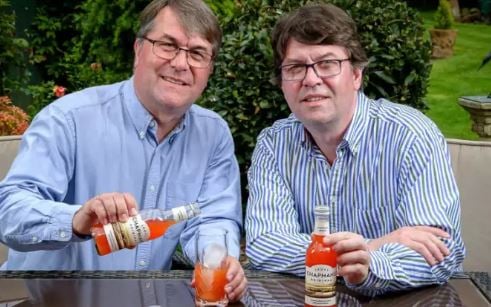
Mike and Garry Robinson, two brothers from Leamington, are selling a Nigerian drink known as ‘Ikoyi Chapmans’ in the UK.
The brothers grew up with their parents in Nigeria where they fell in love with the drink made with citrus fruit and bitters.
Mike and Garry returned to the UK to attend boarding school but they often returned to Nigeria during holidays — and they always had Ikoyi Chapmans each time they came back.
“After leaving school, Garry and I both became professional squash players but it has always been our dream to commercially produce this drink,” Mike told Leamington Courier.
Following their retirement from playing professional squash about five years ago, they embarked on the quest pursue their dream.
“We went to various drinks companies, but many only want an energy drink or a fruit drink,” Mike said.
“We were taking them a drink that had a unique taste.”
Dohler, a drinks company, eventually bought into their vision.
By April, after a bit of experimentation with the flavour and finding a bottling company, the first bottles finally came off the production line.
Ikoyi Chapmans is currently being sold in a few bars and cafes in Leamington and Warwick, and their ultimate goal is to get it on supermarket shelves.
“It was a long, drawn-out process, so it was emotional to see our drink go round the bottling line,” said Mike.
“We were just absolutely elated – we can’t believe it.
Mike and Garry Robinson, two brothers from Leamington, are selling a Nigerian drink known as ‘Ikoyi Chapmans’ in the UK.
The brothers grew up with their parents in Nigeria where they fell in love with the drink made with citrus fruit and bitters.
Mike and Garry returned to the UK to attend boarding school but they often returned to Nigeria during holidays — and they always had Ikoyi Chapmans each time they came back.
“After leaving school, Garry and I both became professional squash players but it has always been our dream to commercially produce this drink,” Mike told Leamington Courier.
Following their retirement from playing professional squash about five years ago, they embarked on the quest pursue their dream.
“We went to various drinks companies, but many only want an energy drink or a fruit drink,” Mike said.
“We were taking them a drink that had a unique taste.”
Dohler, a drinks company, eventually bought into their vision.
By April, after a bit of experimentation with the flavour and finding a bottling company, the first bottles finally came off the production line.
Ikoyi Chapmans is currently being sold in a few bars and cafes in Leamington and Warwick, and their ultimate goal is to get it on supermarket shelves.
“It was a long, drawn-out process, so it was emotional to see our drink go round the bottling line,” said Mike.
“We were just absolutely elated – we can’t believe it.
Mike and Garry Robinson, two brothers from Leamington, are selling a Nigerian drink known as ‘Ikoyi Chapmans’ in the UK.
The brothers grew up with their parents in Nigeria where they fell in love with the drink made with citrus fruit and bitters.
Mike and Garry returned to the UK to attend boarding school but they often returned to Nigeria during holidays — and they always had Ikoyi Chapmans each time they came back.
“After leaving school, Garry and I both became professional squash players but it has always been our dream to commercially produce this drink,” Mike told Leamington Courier.
Following their retirement from playing professional squash about five years ago, they embarked on the quest pursue their dream.
“We went to various drinks companies, but many only want an energy drink or a fruit drink,” Mike said.
“We were taking them a drink that had a unique taste.”
Dohler, a drinks company, eventually bought into their vision.
By April, after a bit of experimentation with the flavour and finding a bottling company, the first bottles finally came off the production line.
Ikoyi Chapmans is currently being sold in a few bars and cafes in Leamington and Warwick, and their ultimate goal is to get it on supermarket shelves.
“It was a long, drawn-out process, so it was emotional to see our drink go round the bottling line,” said Mike.

“We were just absolutely elated – we can’t believe it. - Thecablestyle 

Demonstration of craze !! Stray bullet kills teenager during Oyo LG poll


A teenager simply identified as Kofo was killed by a stray bullet when some hoodlums clashed with personnel of the Nigerian Security and Civil Defence Corps (NSCDC) during Saturday’s local government election in Oyo state.
The incident took place in the Idi Oro area of Ibadan, the state capital.
The girl was said to have gone to a pharmaceutical shop to buy some drugs when she met her untimely death.
NAN gathered from residents that some hoodlums were fomenting trouble in the area when personnel of the NSCDC in the state were called in to quell the violence.
The residents alleged that the girl was killed by a stray bullet belonging to the NSCDC in the ensuing clash.
The hoodlums thereafter attacked the NSCDC divisional office in Ibadan North West local government council at Ekotedo, vandalising the premises.
It was gathered that officers of the NSCDC later mobilised and repelled the attack.
Olusegun Oluwole, spokesman of the NSCDC in the state, confirmed the incident, but said men of the command were not responsible for the killing of the teenager.
Oluwole said the hoodlums were already shooting before the arrival of the NSCDC team.
He told NAN that the case was now under investigation by the police.
“Our men are not responsible for what happened, but I can tell you now that the case is with the police,” he said. - Cable Nigeria

Cultists kill 3 farmers, injure 21 others in renewed clash in Delta


Rampaging cultists terrorizing Cable Point of Asaba and its environs in Delta State have allegedly killed three farmers in the area, and injured twenty-one others in a renewed clash on Friday night.

Mr. Nnamdi Chukwuede, Chairman of Asaba Community Vigilante who spoke to DAILY POST in Asaba, confirmed that the three farmers were shot dead during a rival cult war, while twenty-one others within the area sustained severe injuries, and are presently being treated in a private hospital in Asaba.
He said: “the corpses were deposited at the private hospital mortuary, while efforts were being geared to arrest the perpetrators.
“The victims were killed in a shot out during the cult rival war in the area, we have been doing our best, but it seems the cult groups are increasing by day”.
Investigation revealed that cult related clashes had in the past three years increased in Asaba, Ibusa, Okpanam and its environs with no fewer than forty-three persons killed.
The Police Spokesman in the State, DSP Andrew Aniamaka told DAILY POST that “the identities of the suspects have been unmasked; we are on their trace, we will not relent until they are brought to book”.
Also, the Police Operatives in Ugborikoko community, near Effurun, have arrested three suspected armed robbers in the area, and recovered three locally made guns from them.
The State Police Commissioner, Mr. Mohammad Mustafa who spoke to DAILY POST said: “the police detectives at the Effurun Police Division acted on a tip-off, and swooped on the suspects while they were robbing a prominent business woman, Mrs. Stella Obeh in the area at gun point”.
He warned members of the public against the use of private security guards, adding many of them leaked information to robbers. - Daily post

Defying the tides of misfortune: the migrant babies born at sea

Around 35 babies have been born on migrant rescue ships in the Mediterranean in recent years


Mercy, Francesca, Newman, Diabam and Sophia were the names their mothers chose. What they had no control over was where their babies were born.
As hundreds of thousands of migrants risk their lives on the perilous sea crossing from North Africa to Europe, dozens of newborns have taken their first breath aboard rescue ships in recent years.
"There were a lot of people in the rubber boat, we were all packed together... the pain was awful," said Stephanie, a Nigerian woman who gave birth to Francesca aboard an aid boat.
There are many elements of a tortuous sea crossing that can push pregnant women travelling aboard crammed vessels into labour -- stress, the vibration of boat engines, even the relief of being rescued from danger.
But the chance of a woman having to give birth on the perilous voyage is ultimately a question of numbers.
Since 2014, almost 80,000 women have landed on Italian shores, not including adolescents.
The majority of them are young and many are pregnant.
"I've met many women who were raped," said Marina Kojima, a Japanese midwife who spent several months aboard the Aquarius, a rescue ship jointly run by NGOs SOS Mediterranee and Doctors Without Borders (MSF).
"Often they have to sell their bodies in order to get a place on the boat."
For these women, pregnancy makes the perilous journey through the desert into hellish Libya even more difficult, and giving birth at sea can be a scarring experience.
 Births, deaths 
Giulia Marinig, a recently qualified doctor, remembers a hectic 48 hours in October 2016 when three women went into labour aboard the Dattilo migrant rescue ship.
"We barely had time to realise what was happening and after just 45 minutes a little boy was born," said the 26-year-old.
"I was working on autopilot. Just trying to do my best for the patients, we didn't sleep for two days."
Marinig reckons there were around 30 other heavily pregnant mothers on board the Dattilo, and a number of women carried babies in their arms they had recently given birth to in Libyan detention centres.
Even if their birthing suites amounted to the ship's hard floors with plastic crates as cots, the successful deliveries that night brought a shimmer of light to dark two days -- 10,500 migrants had been picked up in the Mediterranean and a total of 50 corpses discovered.
For relief workers, delivering newborns alive and healthy is such a powerful experience that the European Union re-baptised its anti-trafficking operation in the Mediterranean Sophia in tribute to a Somali girl born in August 2015 on a German ship.
A baby born aboard the Aquarius in 2017 became the inspiration behind this year's French Eurovision entry, simply called "Mercy".
And the tributes go both ways.
Stephanie chose to name her girl Francesca after Pope Francis while little Desire Alex, born on the NGO boat Aquarius in 2016, was named after the ship's captain.
Advertisement
 Citizenship dead-end 
But even if the 35 babies born aboard Mediterranean rescue vessels in recent years defy the odds to make it safely to Europe, their ordeal is just getting started.
According to maritime law, children born at sea are considered nationals of the ship's flag carrier: Italy for Francesca, Germany for Sophia, the United Kingdom for Mercy.
But in these countries, restrictive citizenship laws mean the babies are not entitled to a European passport.
Upon arrival in Italy, their unusual birth affords them no special treatment and they often get lost among the masses.
Mercy and her mother were taken to Mineo reception centre in Sicily, the largest in Europe and long dogged by scandals of embezzlement and trafficking.
It still houses nearly 3,000 people who sometimes wait years for an answer to their asylum applications.
Little Francesca, and two others, Newman and Favor, born on the Aquarius in 2016, were luckier: their parents were taken in by smaller centres which offered legal support, Italian courses and independent accommodation.
On the advice of German sailors, Sophia's mother continued her journey and was granted asylum in Germany.
They all share the same hope: that their children can go to school and grow up to live a life less precarious than their birth. - AFP 

Lesbos: Europe's migrant barrier nears breaking point

In this Friday, May 4, 2018 photo migrants and refugees wait outside the European Asylum Support Service offices inside the camp of Moria on the northeastern Aegean island of Lesbos, Greece. Migration flows are rising, the camps are severely overcrowded the asylum process is slow, fuelling frustration among migrants and island residents. (AP Photo/Petros Giannakouris)


At the heart of Moria, an overcrowded refugee camp on the Greek island of Lesbos, is a dark rectangular building ringed with police guards and coils of razor wire. Taking photographs of it is prohibited.
It's here that thousands of migrants are interviewed by asylum officers — and ultimately informed whether they will ever be allowed to leave the island.
Holding up a tattered asylum card that reads "Forbidden to travel outside Lesbos," 40-year-old Syrian Ziad Rashid said he was supposed to be deported back to Turkey after he unsuccessfully appealed his failed application. But Turkey's effective refusal to re-admit migrants means there's nowhere he can go.
"I've been here for two years," says Rashid, struggling to find the words in broken Greek and English. "It's a big problem."
Lesbos is facing a fourth summer of crisis. It's one of five Greek islands near the coast of Turkey being used by the European Union to form a barrier to migration after more than a million people came through here in 2015-16, heading to western Europe.
But with 7,000 inhabitants, the refugee camp at Moria is now at more than 300 percent capacity, and outbreaks of violence, often triggered by trivial disputes, are increasingly common. A clinic run by the aid group Doctors Without Borders helps treat the sick among the camp's 2,000 children, but has to turn less serious cases away.
Even so, more keep arriving: The number of island arrivals has surged this year from about 50 a day in 2017 to around 200 a day in recent weeks. Asylum applications are backed up by nearly three years, according to Lesbos' regional governor.
Currently, asylum seekers on five Aegean Sea islands — Lesbos, Chios, Samos, Leros, and Kos — are banned from traveling on to the Greek mainland as part of the European Union's controversial "containment policy." That's causing severe overcrowding at the islands' camps, and the government has faced legal challenges and protests against the measure.
Meanwhile, to try to bypass the islands, an even higher number of migrants and refugees are now crossing Greece's heavily militarized land border with Turkey in the northeast of the country.
That has forced Greece to overhaul its policy, and parliament is now debating draft legislation aimed at easing pressure on the islands. Under the proposal, migrants would be allowed to move to camps on the Greek mainland, but they would remain under restriction and could be banned from leaving the regions of the country where they are placed.
The plan has already drawn fire from human rights groups, which argue that containment is to blame for poor living conditions on the islands.
"This situation causes distress, violates people's rights, and insults the dignity of some of the world's most vulnerable people. It's an open wound for Greece and human rights," Dimitra Spatharidou, from the Greek office of Amnesty International, told a parliamentary committee.
Amnesty observers recently visited island camps, and found hundreds of people sleeping in makeshift tents, children sleeping in unsupervised sites, and some resting in fields they say were overrun by rats.
"We saw dozens of men with papers in their hand saying they were suffering from depression, anxiety disorders, and had suicidal dispositions; terrified women at risk of sexual violence in a European country that should be providing them with safety," Spatharidou said.
The government has also promised to speed up the processing of asylum claims by streamlining procedures and hiring additional staff and translators. But new arrivals on Lesbos and other islands are far outpacing the number of people being transported to the mainland on compassionate grounds or because their asylum applications have been approved.
Spread over a hillside, Moria's shoebox-shaped trailers and tents are home to refugees from Syria, Iraq, Congo, and over 50 other of the world's black spots of war and hardship. The camp, crowded but still generally kept in good order, spills into the neighboring fields, where asylum seekers — mostly African men — have little hope of leaving.
Serafin, from Togo, who was too afraid to appear on camera or give his last name, sleeps in a child-sized bunk bed. There are 70 more bunks like his wrapped in gray blankets for privacy and crammed into a single tent they call Little Turkey.
"It's not easy, not easy at all. You can see where we sleep. And the smell," he said, abruptly overcome by melancholy when asked about his prospects. "I don't know what will happen. I miss my family."
The island containment policy started two years ago, when the massive flow of migrants was halted. The EU encouraged countries on the route west to close their borders, asked NATO to patrol the eastern Aegean Sea, and pledged 6 billion euros ($7.1 billion) to Turkey to hold back migrants and accept deportations from Greece.
EU countries have accepted 22,000 refugees from Greece since the agreement between the EU and Turkey was reached, while just 2,000 have been deported to Turkey. That failed to offset new arrivals, and more than 16,000 migrants remain on the islands while more than 40,000 are on the mainland. A planned new round of resettlement has been complicated by the refusal of several EU members including Hungary and Poland to join the scheme.
Advertisement
Dimitris Vitsas, Greece's migration minister, told parliament the new measures will need several months to take full effect.
"A period of difficulty lies ahead. We are fully aware of that fact," he warned lawmakers.
Vitsas traveled to Lesbos last week, along with 19 other members of the Cabinet and the prime minister, to promise more help to the island, from improvements in the ambulance service to faster farm subsidy payments.
In a town hall meeting, Vitsas was berated by island residents complaining about petty crimes that have risen since the camps opened, and others who said they felt their good will toward people fleeing war had been exploited by Greek and European policy-makers.
Many island residents are angry to be missing out on a tourism boom that's helping the country emerge from a decade of financial crisis. Business owners closed their stores for 24 hours in protest at the government visit, and street protests turned violent.

"We all welcomed the refugees. But there is a problem and it has to be taken seriously ... We have a good quality of life here and it's been taken away," said Akis Argiropoulos, a hotel manager in the island's capital, Mytilene. "Without the proper facilities and policing, the island cannot handle all of this burden." - AP

Foreign investors now prefer Abuja to Lagos


Data made available by the National Bureau of Statistics shows that Abuja has displaced Lagos as the city with the largest inflow of foreign capital.
In its report, Capital Importation (Q1), the NBS said Abuja reported inflow of $3.54 billion, up from the $2.68 billion reported in the fourth quarter of 2017.
In the first quarter of 2018, Lagos reported capital importation of $2.67 billion, an increase from the $2.55 billion reported in the fourth quarter of 2017.
Ogun, Bauchi, and Kano states reported growth of 182.06 percent, 370.59 percent, and 154.84 percent on a quarter-on-quarter basis respectively.
Akwa Ibom was the only state to experience a decline amongst all 36 states and including Abuja. Akwa Ibom reported a decline from the $124.85 million in the fourth quarter of 2017 to $43.62 million in the first quarter.
According to the report, the total value of capital imported into the country in the first quarter of 2018 stood at $6,303.63 million, representing a 594 percent increase (year- on–year) from $908.3 million in the 2017.
United Kingdom (UK) remained the lead capital investor in Nigeria in the first quarter of 2018, a position it has occupied since 2010 except for two quarters in 2015.
United States, South Africa and Ghana ranked second, third and fourth respectively.
This the first time since 2013 that Ghana made a significant capital investment in Nigeria.
According to the NBS, portfolio investment attracted the most capital, accounting for 72.42 percent of the total capital importation during the quarter.
Foreign direct investment and other investment accounted for 3.91 percent and 23.67 percent of total capital importation into Nigeria in the quarter under review. - Cable Nigeria